





Summary
In a recent case, the Delhi High Court clarifies the limits of trademark exclusivity in India in the case of composite device marks. The ruling reinforces that overall impression trumps dominant features in such cases, requiring the anti-dissection rule to be followed.
Introduction
Trademark exclusivity has its limits, particularly in relation to common or descriptive elements forming part of composite trademarks. In Anuradha Sharma v. Jiva Ayurvedic Pharmacy Ltd. (FAO (COMM) 334/2025 & CM. APPL. 75353/2025), the Delhi High Court revisited the anti-dissection rule under Section 17 of the Trade Marks Act, 1999 (the Act), while examining questions of infringement and passing off.
At the first instance, the Commercial Court had granted an interim injunction in favour of the Plaintiffs. But this was set aside by the Division Bench (DB) of the Delhi High Court, holding that the rival marks were not deceptively similar. The DB emphasized that composite marks must be assessed in their entirety, and that the inclusion of the prefix “Shatam” and the house mark “By Baidyanath” sufficiently distinguished the Defendants’ marks, thereby negating any prima facie case of infringement or passing off.
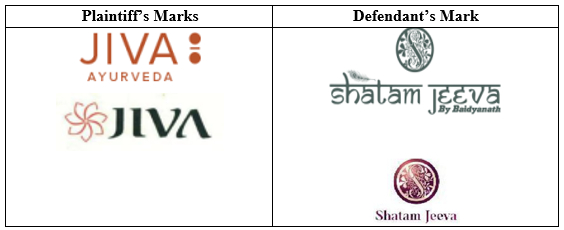
The Facts
The Plaintiffs have used “JIVA” since 1992 for Ayurvedic products and wellness services and hold several trademark registrations, including a lotus device logo.
The Defendants adopted “SHATAM JEEVA BY BAIDYANATH” for a wellness retreat launched in 2021. Per the Defendants, the phrase ‘Shatam Jeeva’, translated to mean, “live for a hundred years”, was adopted as part of the centenary celebrations of the Baidyanath brand. Although the Defendants’ registration was secured in Class 5 in 2018, the Plaintiffs claim to have discovered the mark only in 2022, when it proceeded to file a suit alleging trademark infringement, copyright infringement, and passing off.
After the Commercial Court’s interim injunction in favour of the Plaintiffs, the Defendants preferred an appeal.
The Plaintiffs’ case
The Plaintiffs argued that their trademarks have acquired distinctiveness domestically and abroad. They said that “Jiva” is the dominant part of their mark, and being the common denominator with the rival mark, the similarity between them would likely deceive an average consumer with imperfect recollection. They also contended that the Defendants’ use of this dominant part was in bad faith. The Plaintiffs also argued that even if ‘Jiva’ is a common Sanskrit word, common words can acquire secondary meaning through extensive use.
The Defendants’ case
The Defendants argued that the lower court wrongly assumed that the Plaintiffs held exclusive rights over ‘Jiva’, pointing to use by businesses in various domains, including wellness centres. Being a common Sanskrit word, the Plaintiffs had to establish that ‘Jiva’ had acquired secondary meaning, which they had not done. The Plaintiffs also did not have a registration for the word ‘Jiva’ itself, nor had they applied for one.
The Defendants also contended that the anti-dissection rule was not followed, which requires the marks to be viewed in entirety and not split for comparison. They added that the use of “By Baidyanath” created further distinction, with the brand having acquired immense goodwill and reputation for over a century.
Findings of the Division Bench
Before getting into the arguments, the DB laid down the essential requirements to be met to establish infringement and passing off in trademark disputes.
Necessary conditions
Infringement can be established only if:
(a) the Plaintiffs have a registered trade mark,
(b) the Defendants’ mark is deceptively similar to the Plaintiffs’ registered trademark,
(c) the Defendants’ mark is used in relation to goods or services that are identical or similar to those for which the Plaintiffs’ trademark is registered, and
(d) because of all this, there is a likelihood of confusion in the minds of the public, or the public might assume an association between the two sets of marks.
Here, the DB highlighted that infringement does not rest on the ‘dominant part’ of the marks alone. According to the DB, the test is whether a person of average intelligence and imperfect recollection is likely to be confused between the marks or believe there is an association between them. Dominant features might serve as an aid to conclude thus, but the primary issue is the overall impression created by the rival marks.
Similarly, the DB noted that passing off rests on three things, i.e., goodwill, misrepresentation and damage. Put simply, the Plaintiffs must establish prior goodwill in the mark; that the Defendants’ misrepresentation is likely to deceive the purchasing public; and that there is consequent or likely injury to the Plaintiffs’ goodwill.
The DB noted that the lower court order did not adequately analyse these elements and requirements, and therefore, proceeded to make its own findings.
Infringement
The DB concluded there was no deceptive similarity between the marks and no likelihood of confusion among average consumers. Specifically, there was no phonetic, visual, or conceptual similarity between the two marks, and even ordinary consumers would not mistake the two services.
Several aspects of the Defendants’ marks worked in their favour. For example, the DB held that the word “Shatam” and the phrase “By Baidyanath” clearly distinguishes the source of the products and services. The DB noted that “Shatam”, being a Sanskrit word meaning “hundred”, had no logical or reasonable connection with the Plaintiffs’ mark or products, and thus, no association could be construed. Similarly, “By Baidyanath” signals an intention by the Defendants to differentiate their marks.
Separately, the DB noted that where composite device marks are involved, both visual and word elements impact the likelihood of confusion and overall impression. Here, even if “Jiva” were considered the dominant part of the Plaintiffs’ mark, the overall impression created by the marks in mind of the average consumer is most important. One cannot dissect and isolate “Jiva” and view it independently, particularly since the rival marks are composite device marks.
Passing off
As in the infringement analysis, the DB was satisfied that there is no visual or conceptual similarity between the two marks when examining the competing trade dresses. Additionally, the phrase “By Baidyanath” served as a clear source-identifier, thus removing any doubts of association. Critically, the DB also noted that the Plaintiffs had neither proven loss or harm caused by the Defendants’ mark, nor demonstrated that the Defendants had misrepresented their goods or services as those of the Plaintiffs, both being necessary elements to establish passing off.
The decision
In the circumstances, the DB concluded that no prima facie case for infringement or passing off exists, and the interim injunction order was set aside.
Key Takeaways
The judgment is a reiteration of set principles of trademark law involving composite device marks, i.e., the marks must be compared as whole and not by isolating individual features or words. The test remains one of asking whether a person of average intelligence and imperfect recollection can be confused or make an assumption of association between rival marks. For this, courts must consider the overall impression created by the marks, and not focus on dominant features alone. In such cases, source identifiers and conceptual, visual, and phonetic aspects are useful and important differentiators.
Note that the DB did not go into the substantial question of a common word (Jiva/Jeeva, in this case) being appropriated as a trademark. This decision left unanswered questions of the limits of ownership of a common word, and the requirement of establishing secondary meaning through use, both being issues raised by the parties. Nevertheless, an important takeaway here is that the Plaintiffs could not claim monopoly over the word Jiva/Jeeva (meaning ‘life’), notwithstanding the specific goods/services (i.e., wellness centres) involved.
Additionally, a single instance of possible association is not sufficient to establish likelihood of confusion, and setting up a case for infringement might require stronger evidence. Similarly, an action for passing off requires clearly demonstrating goodwill, misrepresentation and damage, which should be substantiated with proper evidence.














 English
 Chinese (Simplified)
 Japanese