



Summary: With domain names becoming valuable business assets, they have also become targets for abuse. This note explains how brand owners can seek relief, efficiently, at low cost, and without any limitations of jurisdiction, under the Uniform Domain Name Dispute Resolution Policy.
Domain names matter more than ever
Before making a purchase, or engaging a service provider, or even simply responding to an email, consumers search for a company online to verify its authenticity. A company website today is the first point of contact between a business and its customers. Naturally, the domain name becomes an extension of a brand’s identity and reputation.
With the increasing value of domain names, and also with the constant emergence of new generic top-level domains (gTLDs), such as .ai, .app, .shop, opportunities for misuse also grow. Cybersquatting, impersonation, and phishing, are all forms of domain name misuse.
As a defensive tactic, many brand owners instinctively report the issue to the domain name registrar. But registrars are neutral intermediaries, and would not suspend or transfer a domain name upon a complaint. Often, a court order or a decision from a dispute resolution authority is required for obtaining relief.
This is where the Uniform Domain Name Dispute Resolution Policy (UDRP) becomes an invaluable enforcement tool.
About the UDRP
The UDRP was adopted by the Internet Corporation for Assigned Names and Numbers (ICANN) in 1999, and is administered by approved dispute resolution service providers, with the most prominent being the World Intellectual Property Organization (WIPO).
Unlike traditional court proceedings, the UDRP provides a specialised mechanism to determine solely whether a disputed domain name should remain with its current registrant or be transferred to the trademark owner. The UDRP does not replace national courts. Either party is free to commence court proceedings before, during or after the UDRP process if they wish to pursue broader legal remedies.
Using the UDRP
Any owner of a registered trademark, or, in appropriate cases, an unregistered trademark that has acquired sufficient goodwill and distinctiveness, may file a UDRP complaint.
It must be noted that the UDRP is for disputes involving domain names registered under ICANN-accredited generic top-level domains (gTLDs). (Also, usefully, WIPO’s UDRP services handle most gTLDs, e.g., .com, .net, .org, .biz, .info, .app, .xyz, and .ai, among others). Country code domains (ccTLDs) may have separate dispute resolution policies. For instance, .in domain names are governed by the .IN Domain Name Dispute Resolution Policy (INDRP), which operates independently of the UDRP.
Choosing between UDRP and courts
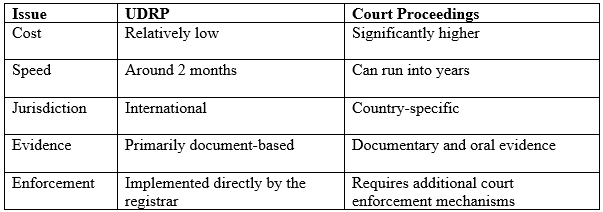
The UDRP’s standout feature is its speed and efficiency. Most UDRP proceedings conclude within two months from the filing of the complaint (contrast with civil litigation, which may take years). The process is entirely online, involving usually just a single round of pleadings, and is decided by panelists with expertise in trademark law and domain name disputes. The decision is implemented directly by the concerned registrar, eliminating the need for separate enforcement proceedings.
The table below explains the difference between UDRP and courts when it comes to handling domain name disputes.
Types of disputes
The UDRP focuses on abusive domain name registrations, rather than every dispute involving a domain name. These include cybersquatting, typosquatting (minor misspellings of a well-known mark), domains incorporating a trademark, phishing websites, fake customer support portals, domains used for business impersonation or passive holding of domain names with no legitimate purpose.
The UDRP is not intended to resolve contractual disputes, trademark infringement claims generally, or ownership disputes between business partners.
Making a successful case under UDRP
To succeed under the UDRP, a complainant must necessarily demonstrate three elements:
1. Identical or confusingly similar
The complainant must demonstrate that the disputed domain name is identical or confusingly similar to its trademark. Minor spelling variations, omitted letters, additional descriptive terms or different domain extensions usually do not prevent a finding of confusing similarity.
For example, additions such as “app”, “support”, “login”, “official” or geographical identifiers will not ordinarily avoid confusion if the trademark remains clearly recognisable.
2. No rights or legitimate interests
The complainant must demonstrate that the registrant lacks any legitimate right or interest in the disputed domain name. If the domain merely capitalises on another’s trademark, this element would be generally satisfied. In contrast, legitimate interest would require showing, for example, that the party is commonly known by the disputed name, it has been using the domain for a genuine business unrelated to the other party, or it is a legitimate non-commercial / fair use of the domain without intending to mislead consumers.
3. Registration and use in bad faith
The complainant must show that the domain name was both registered and used in bad faith. Common indicators of bad faith include:
- registering the domain primarily to sell it to the trademark owner,
- diverting users to competing websites,
- operating phishing or fraudulent websites,
- impersonating the complainant,
- creating email addresses for fraudulent communications and
- using the domain to attract users by creating trademark confusion.
Evidence for strong complaint
The basis of a successful complaint is clear, credible and useful evidence. No lengthy submissions are required.
Useful evidence could include the following, in no particular order:
- trademark registration certificates,
- screenshots of the disputed website,
- historical website captures,
- evidence of the complainant’s reputation, e.g., media coverage, sales and advertising, social media presence,
- phishing emails from the domain,
- customer complaints demonstrating actual confusion and
- WHOIS records and registrar information.
An inactive website does not necessarily prevent a finding of bad faith, as panels have held that passively holding a domain name may itself constitute bad faith if the facts show as much. In such cases, evidence around the reputation of the trademark and the surrounding circumstances could be useful.
The UDRP process
The procedure usually follows these steps:
- The trademark owner files a complaint with a dispute resolution provider, e.g., WIPO.
- The provider verifies the registration details with the registrar.
- The complaint is formally notified to the registrant.
- The registrant is given an opportunity to submit a response.
- A panel comprising one or three independent experts is appointed.
- The panel issues its written decision.
- If the complaint succeeds, the registrar implements the transfer or cancellation of the domain name after the prescribed waiting period, unless court proceedings are commenced.
Most proceedings conclude within approximately 60 days.
Costs
Costs depend on the number of disputed domain names and the size of the panel (single-member or three-member panel). A complaint for one to five domain names before a single-member panel at WIPO at present carries a filing fee of USD 1,500. The respondent generally need not pay any fees unless it seeks a three-member panel for resolving the dispute.
Remedies
Significantly, and unlike in civil litigation, the UDRP does not award monetary compensation.
The panel may only order transfer of the domain name to the complainant, or cancellation of the domain name, or dismissal of the complaint.
Where a complaint is found to have been brought in bad faith, the panel may also declare it to constitute Reverse Domain Name Hijacking (RDNH), signalling that the UDRP process has been misused.
Takeaways for brand owners
Brand owners can reduce enforcement costs by taking proactive steps, including:
- Registering key domain names alongside trademark filings.
- Securing common spelling variations and important gTLDs and ccTLDs.
- Regularly monitoring for domain names incorporating the
- Preserving screenshots and other evidence upon discovering misuse.
- Acting before consumer confusion escalates.
- Maintaining an updated trademark portfolio across key jurisdictions.
- Seeking legal advice early for strategic decisions, e.g., UDRP or courts.
The UDRP offers brand owners an efficient and proven mechanism for recovering domain names that are registered and used in bad faith. The procedure is accessible and cost-effective, but success depends on a well-supported complaint meeting the UDRP’s three essential requirements.
A proactive brand protection strategy in today’s digital economy would involve ̉combining trademark registrations, strategic domain name registrations, regular monitoring and timely enforcement, to minimise the risks from cybersquatting and other online brand abuse.














 English
 Chinese (Simplified)
 Japanese