




Summary: If you think supply chains are a shield against patent lawsuits, think again. In a landmark January 2026 ruling, the Delhi High Court confirmed that even if you outsource the “infringing step,” you can still be held liable for infringement. By using purposive claim construction and the concept of indirect infringement, the Court held that if the end-product embodies a patent, the commercial benefactor is liable.
Introduction
Identifying actors in patent infringement requires pinning down the party directly manufacturing a patented product or performing the patented process in question. But modern industries rarely operate through a single entity alone. Deeply fragmented manufacturing and supply chains make the task of identifying the infringing actor increasingly difficult. Often, an entity may avoid performing the patented step entirely, while still facilitating, enabling, or commercially benefiting from the use of the patented technology.
Such situations can be addressed through the doctrine of indirect infringement, which includes concepts such as contributory infringement and inducement. These help establish liability even when parties are outsourcing or distributing parts of an infringing activity across different entities.
A recent case involving DVD replication, and the global technology giant, is a milestone in Indian patent jurisprudence, as one of the clearest judicial recognitions of the concept of indirect infringement in India. Even though the Indian Patents Act (the Act) does not explicitly recognise indirect infringement, the Delhi High Court has shown that existing legal principles, e.g., purposive claim construction and protection of products obtained from patented processes, can effectively address such situations.
For patent holders, this ruling strengthens patent enforcement against parties trying to circumvent liability through fragmented supply chains. For technology businesses, it is a reminder that outsourcing manufacturing may not be a shield from infringement liability if the resulting product embodies patented technology.
Indirect infringement in India
The Indian Patents Act, 1970 (the ‘Act’) does not statutorily define or refer to contributory or induced infringement, these have been recognized by Indian courts in various cases.
In Roche v. Cipla (RFA (OS) Nos. 92/2012 & 103/2012), the Delhi High Court recognised that, during infringement analysis, “purposive construction of the claims is necessary in order to not construe claims too narrowly.” In effect, the Court acknowledged that infringement analysis must consider substance over form, opening the door to liability beyond literal acts of manufacture.
In Intex Technologies (India) Ltd. v. TLM Ericsson, 2023 SCC OnLine Del 1845, the same Court applied a two-step test, as follows:
- Mapping the patent claims to the relevant industry standard; and
- Demonstrating that the infringing product/device complies with that standard.
When diagrammatically represented, if A=Patent; B=Standard; and C=Defender’s device, then:
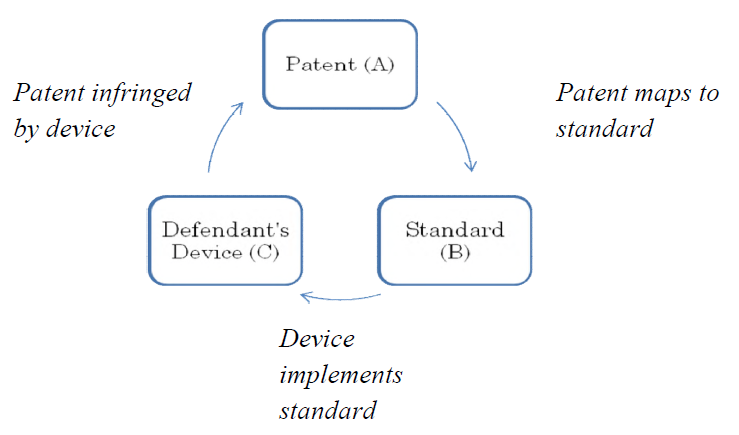
Thus, if a product complies with the relevant standard, a court may infer that the patented technology is used, without requiring proof of every technical step. This test was also applied in LAVA International Ltd. v. Telefonaktiebolaget LM Ericsson (2024 SCC OnLine Del 2497).
The Philips – DVD Replicators case
In a recent decision involving commercial replication of DVDs, the Delhi High Court tackled indirect infringement outright. The decision in Koninklijke Philips N.V. v. Maj (Retd) Sukesh Behl & Anr (CS(COMM) 423/2016) concerned Indian Patent No. 218255, owned by Koninklijke Philips N.V (‘Philips’), titled “Method of Converting Information Words to a Modulated Signal.”
The patent relates to Eight-to-Fourteen Modulation Plus (EFM+) encoding, a technology used in DVDs to convert digital information into modulated signals that can be reliably stored and read on optical discs. The patent contained thirteen claims:
- Claims 1–11 and 13: method claims relating to the EFM+ encoding process.
- Claim 12: a product claim directed to a record carrier containing the modulated signal generated through the patented method. Claim 12 effectively covered a storage medium, such as a DVD, that contains data encoded using the EFM+ technique, as claimed in the method claims.
- For reference, Claim 12 states: “Record carrier on which the modulated signal obtained by the method claimed in any one of the preceding claims is provided in a track.”
The Defendants’ Case
The Defendants argued that while they were engaged in commercial DVD replication and producing DVDs for distribution, they did not perform the patented encoding process themselves, and therefore, were not liable for infringement.
According to the Defendants, DVD replication involves a largely mechanical process: first, a stamper, i.e., a metal template containing encoded data, is created; then, the stamper is used during injection moulding to replicate DVDs by reproducing the same pattern of pits and lands on the disc surface. The Defendants stated that encoding as per the claimed method occurred only during the creation of the stamper, which was carried out by third-party manufacturers (e.g., Moser Baer).; whereas their role was limited to mechanical replication, which did not involve the patented process.
The Plaintiff’s Case
Philips, on the other hand, argued that the Defendants had themselves commissioned stampers containing EFM+ encoded data, used these stampers to replicate DVDs on a commercial scale, and then sold these DVDs that necessarily embodied the patented technology. They also emphasised that the patent was a Standard Essential Patent (SEP) for DVD technology, which meant that DVDs necessarily incorporate EFM+ encoding. Therefore, even if the Defendants did not personally perform the encoding step, they knowingly used and sold products derived from the patented process.
The Single Judge Decision
The Delhi High Court, recognising the principles of indirect infringement, in a decision of a Single Judge Bench dated 20 February 2025, clarified that a third-party infringer can be held liable for the actions of others if they collaborated and acted in a concerted manner to undermine the patentee’s rights. This was especially significant for patents involving SEPs, where a party may be held liable for indirect infringement if they facilitate or enable the use of a patented technology covered by the standard. A case in point would be the manufacturing or supplying components specifically designed for standard-compliant products or providing technical assistance implementers.
Applying these principles, the Court rejected the Defendants’ attempt to avoid liability. The Court noted that Claim 12 was a product claim covering any record carrier containing the EFM+ encoded signal, regardless of the specific method used to create the DVD. The Court also relied on Section 48(b) of the Act, which grants the patentee the exclusive right to prevent third parties from selling or using a product obtained directly from a patented process.
The Court held that even though the patented EFM+ encoding step was carried out by a third party, the Defendants knowingly procured encoded stampers and used them for large-scale DVD replication. Therefore, DVDs containing the encoded signal fell within the scope of the patent even if the Defendants themselves did not perform the encoding step.
The Division Bench Decision
The 2025 Single Judge decision was challenged before a Division Bench of the same court, which was decided on 5 January 2026. By this time, the underlying patent had already expired, and therefore, the proceedings primarily concerned the damages awarded for past infringement. Nevertheless, the Division Bench summarised the reasoning of the Single Judge, particularly the interpretation of Claim 12 as a product claim covering record carriers containing EFM+ encoded data. The Bench also reinforced the broader principle that commercial exploitation of products embodying patented technology may attract liability even if the accused party does not perform the patented process itself.
Key Takeaways
- Indian patent law does not explicitly recognise indirect infringement. But Indian courts decisively addressed indirect infringement through broader interpretative principles.
- Section 48(b) of the Patents Act allows patentees to prevent the sale of products obtained directly from a patented process. Thus, product claims linked to process claims may capture products derived from the patented process, even if the accused party did not perform the process itself.
- Outsourcing a step of a patented process does not necessarily shield a party from liability.














 English
 Chinese (Simplified)
 Japanese